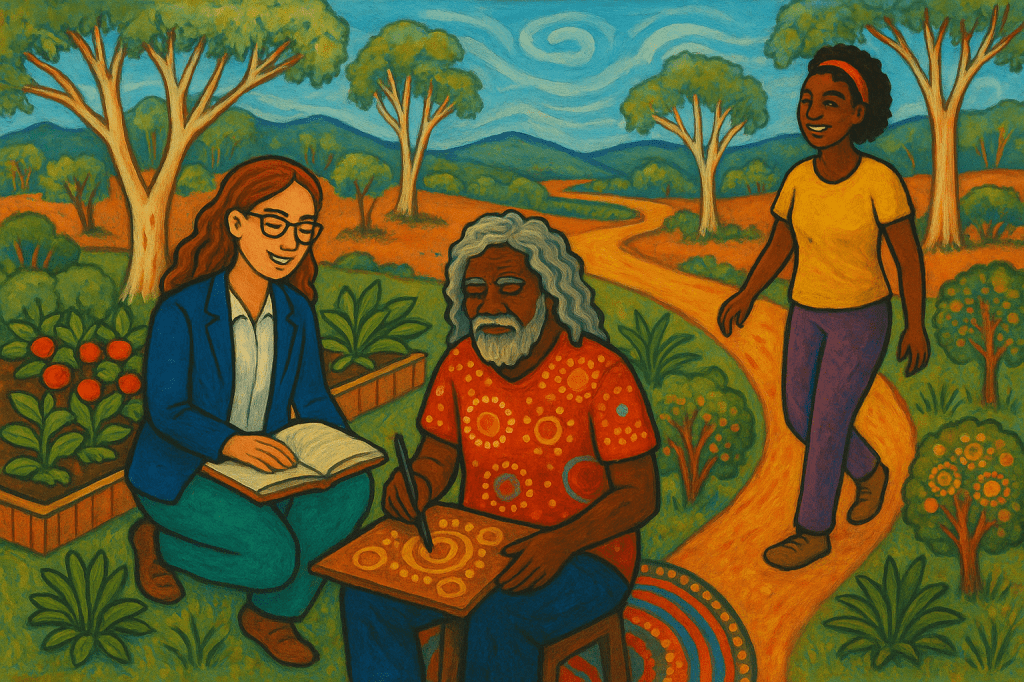
As a general practitioner and researcher, I see firsthand how our healthcare system struggles to meet the needs of patients whose health is shaped not just by biology, but by the social and cultural worlds they live in. That’s why I was so heartened to read the recent paper by Munro and colleagues (2024), which explores the promise of community-led social prescribing—an approach that doesn’t just treat illness, but strengthens communities.
For those unfamiliar, social prescribing is a way for healthcare professionals to connect patients with non-medical forms of support in the community—like walking groups, gardening clubs, housing support, or cultural activities—based on what matters most to the patient. It’s about recognising that health isn’t created in clinics alone. But while the model has gained traction in recent years, the version Munro et al. advocate for goes one step further.
Shifting Power to the Community
The standout message from this study is clear: to truly address the social determinants of health, we need to shift power. That means moving beyond models where social prescribing is controlled solely by healthcare systems and instead investing in community organisations as equal partners—or even leaders—in delivering care.
Munro and colleagues argue that community-led social prescribing is not just an add-on to the system but a powerful means of transforming it. It reframes people not as service users, but as citizens with skills, stories, and strengths. And it trusts communities to know what’s best for their people.
What Makes This Model Different?
Traditional models often centre around “link workers” based in general practices who refer patients to local services. While important, this model can feel top-down and overly medicalised. In contrast, community-led approaches begin in the community and are driven by the community—from grassroots organisations to local volunteers and people with lived experience.
The researchers highlight key ingredients that make this model work:
- Long-term, flexible funding so that community organisations can plan and grow sustainably.
- Equity-focused design, ensuring marginalised groups are not left behind.
- Recognition of community capacity—acknowledging that healing and connection happen in spaces that aren’t always clinical.
Why It Matters—Especially Now
In the wake of COVID-19 and under the weight of health system pressures, many patients are presenting with complex, chronic issues that don’t have a simple prescription. Social isolation, housing insecurity, cultural disconnection, and poverty all take a toll. A more relational, community-powered model of care could help bridge these gaps.
The article also resonates with what I’ve seen in my work across Australia’s remote communities. Whether it’s a local arts group, an Indigenous ranger program, or a neighbourhood kitchen, health springs from connection. As Munro et al. (2024) remind us, “community-led” is not just a buzzword—it’s an act of structural change.
Where Do We Go From Here?
The shift won’t be easy. It requires letting go of top-down control, building real partnerships, and valuing outcomes that can’t always be counted on a spreadsheet. But the evidence is growing—and so is the movement.
For policymakers, this means funding not just services, but relationships. For clinicians, it means listening differently. And for all of us, it means recognising that health is something we build together.
Reference:
Munro, A., South, J., O’Shea, A., Greaves, F., & Bickerdike, L. (2024). Community-led approaches in social prescribing: insights from UK practice. Perspectives in Public Health, 144(2), 79–85. https://doi.org/10.1177/17579139241229303





Leave a comment