Adopting lifestyle medicine principles is not just about avoiding disease; it’s about thriving. By making deliberate, sustainable changes in nutrition, movement, sleep, stress management, relationships, and avoiding harmful substances, individuals often experience profound transformations more energy, better mental clarity, improved mood, and a greater sense of purpose. How Lifestyle Medicine Can Transform Your Life is evident through these positive changes.
Scientific research consistently shows that lifestyle interventions can prevent, manage, and even reverse chronic conditions like heart disease, type 2 diabetes, obesity, hypertension, and depression. But beyond the medical benefits, embracing these pillars means reclaiming your life, your joy, and your ability to engage with the world around you fully.
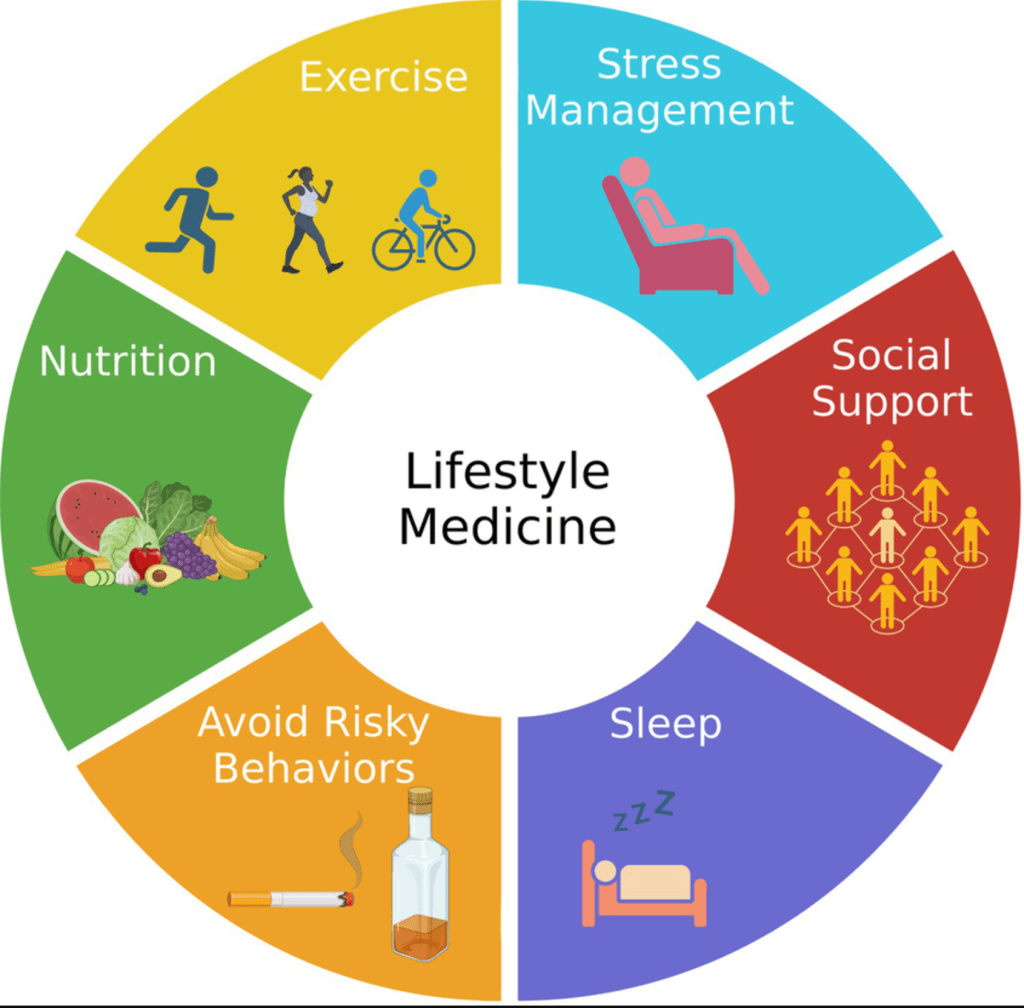
The core components of lifestyle medicine are encapsulated in its six foundational pillars:
Nutrition: Emphasizing a whole-food, plant-predominant eating pattern rich in vegetables, fruits, whole grains, legumes, nuts, and seeds. This diet provides essential nutrients and has been shown to prevent and manage various chronic diseases.
- Physical Activity: Engaging in regular and consistent physical activity combats the negative effects of sedentary behavior. It is important to engage in both general physical activity as well as purposeful exercise weekly as part of overall health and resiliency.
- Restorative Sleep: Prioritizing quality sleep is essential for overall health. Striving for seven or more hours per night allows the body to reset and recover, supporting various bodily functions and enhancing well-being.
- Stress Management: Incorporating stress-reducing behaviors is essential for whole-person health.
- Social Connection: Strengthening and maintaining relationships and connections with others that bring meaning and purpose to life.
- Avoidance of Risky Substances: Reducing or eliminating the consumption of or exposure to any substances that cause harm through toxicity, addiction, physical damage, or adverse side effects.
By focusing on these six pillars, lifestyle medicine offers a holistic approach to health, addressing the underlying causes of chronic diseases and promoting sustainable well-being. How Lifestyle Medicine Can Transform Your Life is not just a statement; it’s a call to action for a healthier, more fulfilling existence.
A Story of Renewal: The Road Back to Life
The morning sun filtered through the half-closed blinds, casting soft golden lines across Emma’s bedside table—a quiet reminder of how much had changed in the last year.
She stretched, slowly, deliberately. No longer stiff. No longer weary before the day even began.
A year ago, mornings had been different. She had woken up exhausted, trapped beneath the weight of fatigue that no amount of sleep could erase. Her body ached, her joints protested, and her mind was a fogged-over landscape of endless to-do lists and unfinished conversations.
She had blamed stress. Blamed her age. Blamed the world for its relentless demands. It wasn’t until her doctor had sat her down and gently uttered the words ‘lifestyle medicine’ that something shifted.
“Let’s not just treat the symptoms,” he had said. “Let’s change the foundation.”
At first, Emma had resisted. It was easier to swallow pills than to change habits. But desperation had a way of cracking even the most stubborn walls.
She started small. A 10-minute walk became a 30-minute walk. A processed, sugar-laden breakfast became a bowl of fresh berries, nuts, and oats. Late-night scrolling was replaced with reading, deep breathing, and an actual bedtime routine.
She didn’t see changes overnight. But slowly, imperceptibly, something shifted.
Her energy no longer crashed by mid-afternoon. The dark, anxious thoughts that had once haunted her sleepless nights began to loosen their grip. The headaches, the creeping weight gain, the joint pain—all began to fade like mist in the morning sun.
And then came the moment she knew she had reclaimed her life.
It was a Saturday. Just an ordinary, blue-skied Saturday. But instead of collapsing on the couch, drained from a week of survival, she was lacing up her sneakers, ready to meet her friends for a hike.
And as she reached the top of that hill, lungs full of air, heart full of gratitude, she realized something astonishing:
She was not just surviving anymore.
She was living.
Reference List
- American College of Lifestyle Medicine. (n.d.). The six pillars of lifestyle medicine. Retrieved from https://lifestylemedicine.org
- Rippe, J. M. (2019). Lifestyle medicine: The health-promoting power of daily habits. Journal of the American College of Cardiology, 73(16), 2011-2013. https://doi.org/10.1016/j.jacc.2019.02.041
- Katz, D. L., & Meller, S. (2014). Can we say what diet is best for health? Annual Review of Public Health, 35, 83-103. https://doi.org/10.1146/annurev-publhealth-032013-182351
- World Health Organization. (2018). Physical activity and sedentary behavior: WHO guidelines. Retrieved from https://www.who.int/publications/i/item/9789240015128
- Ornish, D., Lin, J., Chan, J. M., Epel, E., Kemp, C., Weidner, G., & Blackburn, E. H. (2013). Effect of comprehensive lifestyle changes on telomerase activity and telomere length in men with prostate cancer: 5-year follow-up of a descriptive pilot study. The Lancet Oncology, 14(11), 1112-1120. https://doi.org/10.1016/S1470-2045(13)70366-8
- National Sleep Foundation. (2020). How sleep affects health and well-being. Retrieved from https://www.sleepfoundation.org
- Chatterjee, R., Chapman, T., Brannan, M. G., & Varney, J. (2017). Gaining momentum: Learning about the feasibility of embedding social prescribing in primary care. Journal of the Royal Society of Medicine, 110(11), 435-440. https://doi.org/10.1177/0141076817738502
- Egger, G. (2019). Lifestyle medicine: The ‘why’, ‘what’ and ‘how’ of a developing discipline. Australian Journal of General Practice, 48(10), 665-668. https://doi.org/10.31128/AJGP-06-19-4964
- Family Medicine, University of Pittsburgh. (2023). UPMC Lifestyle Medicine: The six pillars. Retrieved from https://www.familymedicine.pitt.edu/upmc-lifestyle-medicine/six-pillars-lifestyle-medicine
Image Attribution:
The image featured in this post was sourced from Fischer et al. (2023), which explores the relationship between diet, lifestyle, and Alzheimer’s dementia progression. Fischer, K., Carpenter, A. R., & Love, G. D. (2023). Diet and lifestyle impact the development and progression of Alzheimer’s dementia. ResearchGate. Retrieved from https://www.researchgate.net/publication/372410795_Diet_and_lifestyle_impact_the_development_and_progression_of_Alzheimer’s_dementia







Leave a comment